
The first 72 hours
The three days that set the rest of the rearing year. An hour-by-hour walk through what the good sheds do — and the seven boring habits that prevent most pre-weaning deaths.
Most calf deaths under thirty days happen between day three and day fourteen. Almost all of them can be traced back to a decision — or a missed one — in the first 72 hours of the calf's life. The good news is, doing those 72 hours well takes maybe an hour of actual work, spread across three days. And most of that hour is worth its weight in gold.
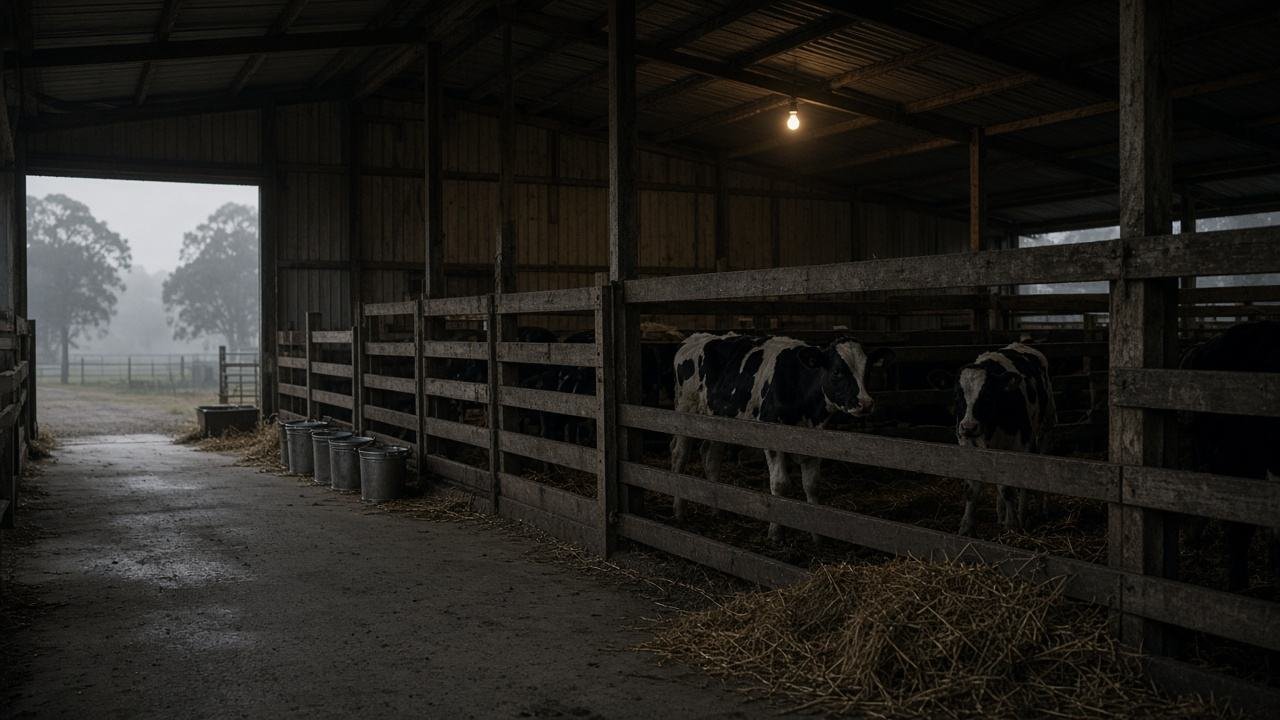
This is the hour-by-hour walkthrough of what to do, and why, from the moment a wet calf hits the straw to the morning of day three when she should be bouncing.
Hour 0 — the calving
You've been watching the cow for the last half hour. The amnion's gone, two feet then a nose, and a moment of relief when the calf takes her first breath. The first three things to do are not optional, no matter what else is happening in the shed.
- Make sure she's breathing. Clear the nose and mouth with clean fingers. If she's slow to start, hang her over a gate (drainage) or rub her vigorously with a towel — that's enough to stimulate breathing 95% of the time.
- Dip the navel in 7% iodine. Within the first hour. Not optional. Navel ill (omphalitis) is one of the top three causes of pre-weaning death — and iodine within the hour cuts the risk by roughly 80%.
- Record the calving — birth type, time, dam, sire, pen. Two minutes. The data you capture here saves you a hundred questions later.
Hour 1 — the golden hour
This is the bit we've written a whole separate essay about, so we'll keep it short. Four litres of good colostrum (≥22% Brix), into the calf, within the first hour. Bottle if she'll take it, tube if she won't. Record what went in.
One feed at hour 1 gives more passive immunity than three feeds spread across twenty-four hours. If your shed only ever optimises one thing, optimise this.
Hours 1 to 12 — top up and observe
Once the first feed is in, the rest of the morning is about consolidation.
- Second colostrum feed at around six hours, roughly 2 litres. Target total colostrum in the first 12 hours: 10–12% of bodyweight — that's 4–5 L on a 40 kg heifer.
- Check on her every few hours. Is she up? Standing? Bright? Any sign of difficulty breathing?
- Move her to the calf shed once she's dry and stable. Clean, dry, draught-free bedding. (The "dry" part matters more than people give it credit for — wet bedding is a magnet for the bugs that cause scours.)
Why the first 12 hours matter so much
This is the window where failure of passive transfer happens — or doesn't. After this point you cannot fix it. You can only manage the consequences. That's why the good sheds spend more time on the first 12 hours of a calf's life than on any other single day of her rearing.
Hours 12 to 24 — transitional milk
Once the gut is closed and the colostrum window is done, the calf moves from colostrum to transition milk — that's the second to sixth milking from the dam. Or, if your system uses milk replacer, straight to replacer.
Transition milk is the bit a lot of farms skip. It shouldn't be. It still has growth factors and immunoglobulins in lower concentration than colostrum, and it gives the gut wall a few more days of "training wheels" before it goes onto pure replacer or whole milk. Calves that go straight from colostrum to replacer at hour 12 tend to scour more in week 2 — there's solid evidence on this.
Set the calf up on her regular feeding schedule. For most systems that's 2 L per feed, twice a day, building up over the first week.
Continue navel iodine if you're doing twice-daily dips for the first 24–48 hours. (Many vets recommend it. The juice on the cord wicks bacteria up the umbilical stump; a second dip kills off what the first one missed.)
Day 2 — watch and weigh
By the morning of day two, the calf should be alert, dry-nosed, and interested in her milk. The job of day 2 is observation, with a side of arithmetic.
- Two full feeds. Watch each one. Is she drinking enthusiastically? Any pause? Any holdback? Note the small things.
- Weigh her if you can. Even a heart-girth tape estimate is better than nothing — it gives you a usable baseline ADG from here on.
- Flag any concern at the first hint. Loose pat. Slow drinker. Slightly listless. A flag is a 10-second insurance policy against forgetting; a sick calf at day 2 is almost always recoverable, but only if you catch it now.
Day 2 is where the early problems show. Catch them now and most of them are fixable with electrolytes alone — no antibiotics needed. Miss them and you're treating scours in week 1.
Day 3 — the critical window
This is the day when, looking at her, you'll roughly know what kind of calf you're going to have.
If she's drinking, alert, getting up easily, dry-nosed — she's through the danger zone. Carry on.
If she's been on a watch flag for two days and still hasn't improved, today's the day to escalate. Take her temperature (normal: 38.5–39.0°C). Skin tent test. Listen to her chest. Make a real decision.
If your protocol calls for coccidiosis prevention from day 0, day 3 is the day to make sure that dose has actually been recorded. (The good ones are easy to forget by the third one.)
The 72-hour checklist
The bit you can actually pin to the shed wall. If you do all seven of these on every calf, you've removed roughly 80% of the preventable risk in pre-weaning. Everything that comes after — feeding, vaccines, weaning — is much easier to get right.
First 72 hours — the seven boring things
- Navel dipped in 7% iodine within the first hour (and re-dipped at 12 hours).
- 4 L of ≥22% Brix colostrum in the first hour, recorded with time and volume.
- Top-up colostrum feed at ~6 hours.
- Transition milk for at least 1–3 days before pure replacer.
- Calf moved to clean, dry, draught-free bedding within 12 hours.
- Weight estimated and recorded by day 2 (tape is fine).
- Calving event recorded in your records — birth type, dam, time, pen.
What goes wrong when you skip steps
Each shortcut has a specific failure mode. They're surprisingly predictable:
- Skip the navel dip → joint ill, septicaemia, often a dead calf at day 5–10.
- Skip the colostrum or feed late → failure of passive transfer, scours in week 1–2, antibiotic course by day 7.
- Skip transition milk → higher scour risk through week 2 and 3.
- Skip the day-2 observation → miss the early warning that catches scour before it's a treatment.
- Skip the recording → no data to learn from when next year's mob has the same problem at the same age.
One thing to take away
You cannot fix a bad start. You can only have a good one.
Most calves who die under 30 days are calves who got something wrong in the first 72 hours — colostrum, navel, hygiene, or just timing. Front-load the work. An hour of careful attention across three days pays you back for the next three months.
P.S. — Want a printable "First 72 Hours" laminated shed checklist? Email calfmate@farmsystem.com.au and we'll send the PDF.
Record the first 72 hours in 30 seconds per calf
Calfmate's calving and colostrum screens are built around exactly this workflow — designed to be operable in the shed with cold hands. 30 days free, no card needed.